



 Plastic Sheet


 Food Containers


 Sealing Film


 Food Packing Machinery
  One-Stop Solutions

CPET Packaging Manufacturer Selection: A Step-by-Step Guide

Selecting the right CPET packaging manufacturer is a critical decision that directly impacts your food safety, brand reputation, and bottom line. With the global demand for microwaveable and oven-safe ready meals surging, finding a supplier who can deliver consistent quality, regulatory compliance, and scalable capacity is more challenging than ever. A poorly chosen supplier can lead to warped trays in the oven, seal failures in the cold chain, or costly production delays. This comprehensive guide walks you through a systematic, five-step approach to evaluating CPET suppliers, helping you avoid costly mistakes and partner with a manufacturer that truly supports your business growth.
Key Takeaways
Define your packaging needs first. Specify temperature range, material grade, and certifications.
Check each manufacturer's production capacity and quality control. Look for advanced equipment and R&D support.
Verify FDA, EU, and ISO certifications. These ensure food safety and regulatory compliance.
Compare total costs, including unit price, MOQs, and lead times. Request samples before bulk orders.
Choose a manufacturer with a strong reputation and sustainable options. Look for recyclable materials and eco-friendly practices.
1. Define Your CPET Packaging Requirements
Before contacting any CPET packaging supplier, you must document your exact product specifications. This preparation prevents miscommunication and ensures the final trays perform correctly in your specific application. A clear requirements document also helps you compare quotes from different suppliers on an equal basis.
Material Specs and Temperature Range
The most critical specification for CPET trays is their temperature tolerance. These trays must transition directly from freezer storage into conventional ovens and microwaves with minimal deformation. The primary specification for freezer-to-oven applications is -40°C to +220°C (-40°F to 428°F). Many North American products use 400°F / 204°C as the practical upper limit for conventional oven use. For freezer storage, trays are rated down to -40°C / -40°F.
Technical Requirement | Specification |
|---|---|
Temperature range | -40°C to 220°C (freezer-to-oven safe) |
Material grade | Food-grade, high-performance CPET |
Mechanical property | Rigid, maintains shape and appearance |
Sealing performance | Strong, reduces leak or contamination risk |
Barrier property | Excellent, preserves taste, texture, and freshness |
Pro Tip: Specialty grades of PET, known as CPET, can offer a wider temperature range for microwave applications compared to ordinary PET.
Thickness also matters for your CPET packaging. The typical thickness range spans 0.18–1.8 mm, depending on the application. Thermoformed packaging boxes, microwave heating food trays, airline tableware, and frozen meal packaging each demand different thickness levels. Precise thickness control ensures the tray maintains rigidity during handling and cooking. A reliable CPET packaging manufacturer should offer multiple thickness options to match your product weight and cooking requirements.
Certifications and Design Needs
Your CPET packaging manufacturer must hold recognized food-safety certifications. Look for ISO, FDA, and SGS compliance to verify that materials meet regulatory standards. These certifications confirm that the packaging will not leach harmful substances into food during heating. Safety should never be compromised when selecting packaging solutions for food products.
Design requirements extend beyond basic dimensions. Consider whether you need high-barrier versions for extended shelf life and gas flush applications. You might also require specific sealing films that create airtight, leakproof barriers. A manufacturer offering integrated packaging solutions—from plastic sheets to finished trays—simplifies this process. HSQY, for example, provides PET, PVC, PP, and EVOH sheets alongside CPET trays, allowing one-stop sourcing for all your packaging needs. This approach eliminates compatibility issues between trays and sealing films.
Finally, consider whether your application requires dual-ovenable trays that work in both conventional and microwave ovens. Documenting these design needs upfront helps your manufacturer recommend the right material grade and thickness for your specific product.
2. Evaluate a Manufacturer’s Capabilities
Once you define your requirements, the next step involves assessing each manufacturer's operational strength. Production capacity and technical expertise determine whether a supplier can deliver consistent quality at scale.
Production Capacity and Equipment
Factory scale directly impacts delivery reliability. A manufacturer with multiple facilities and numerous production lines can handle large orders without compromising quality. HSQY operates 7 factories with advanced production lines, demonstrating substantial capacity for bulk CPET packaging orders. This scale also provides flexibility for seasonal demand fluctuations.
Equipment sophistication matters equally. Advanced thermoforming machinery produces trays with precise thickness control and uniform wall distribution. Ask about the age and maintenance schedule of production equipment. Older machines may produce inconsistent results, especially for dual-ovenable trays that require exact material distribution.
Quality Control and R&D Support
Quality control systems protect your brand reputation. Verify that the manufacturer conducts in-process inspections and final product testing. Research and development capabilities separate commodity suppliers from true partners. An in-house R&D team enables custom mold design and specialized material formulas. HSQY's dedicated R&D staff exemplifies this approach, offering tailored food packaging solutions that address specific market needs.
Ask about their prototyping process. A responsive R&D team provides samples within days, not weeks. This speed accelerates your time-to-market and allows thorough testing before committing to large volumes.
3. Check Compliance and Certifications for Packaging
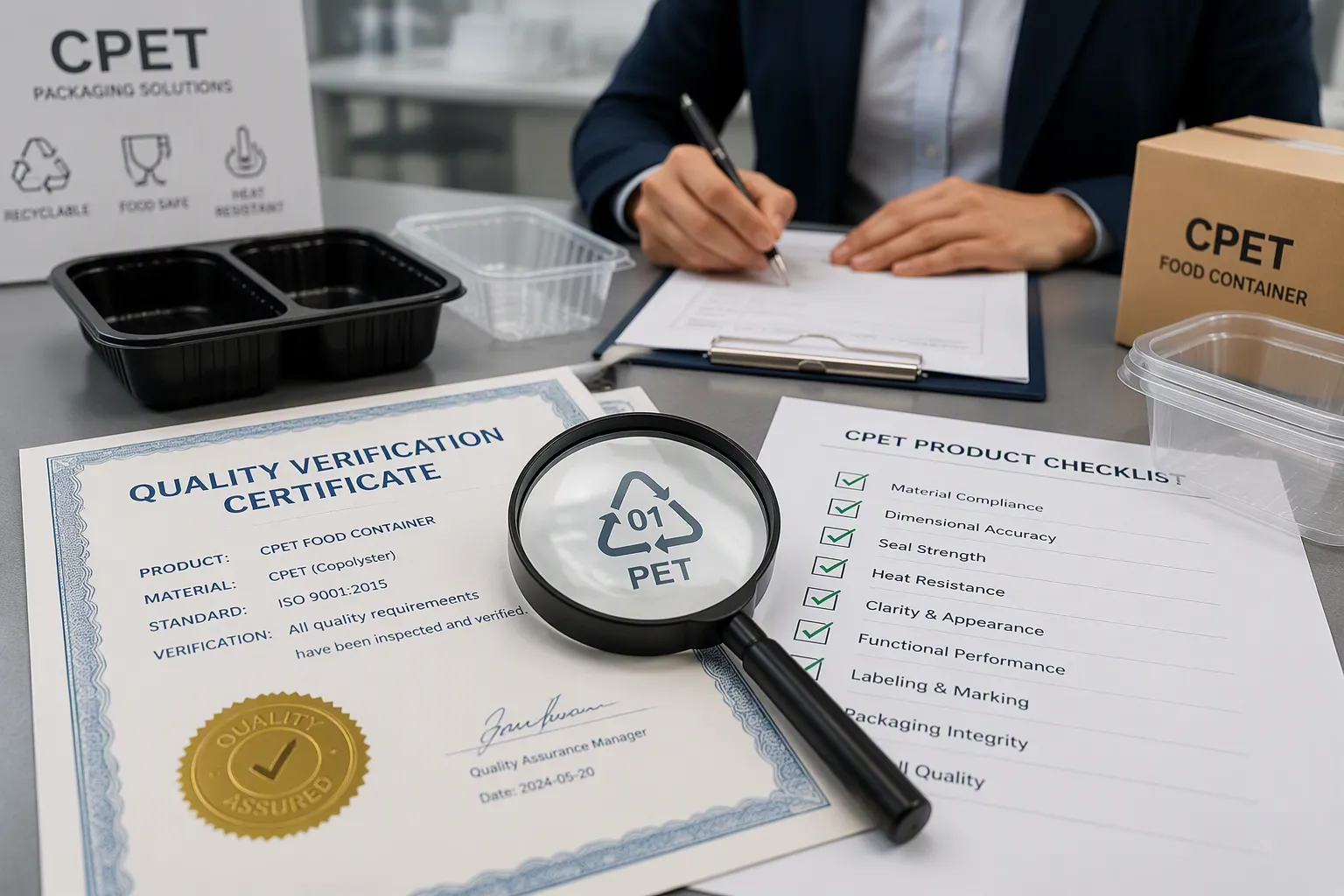
Regulatory compliance protects your brand and your customers. A trusted CPET tray supplier must prove its materials meet strict food-contact standards. Without proper certifications, you risk product recalls and legal liability.
FDA, EU, and BRC Standards
The U.S. Food and Drug Administration (FDA) regulates materials that contact food. FDA compliance confirms that CPET trays will not transfer harmful substances during heating. The European Union enforces similar rules through Regulation (EC) No 1935/2004. A manufacturer serving global clients should hold both FDA and EU approvals.
The British Retail Consortium (BRC) standard adds another layer of assurance. BRC certification demonstrates rigorous quality management throughout production. HSQY holds ISO, FDA, and SGS certifications, confirming compliance across multiple jurisdictions. These credentials verify that every tray leaving the factory meets food safety requirements.
ISO and Sustainability Credentials
Beyond basics, sustainability credentials are becoming essential. Retailers increasingly demand proof of recyclability and recycled content in packaging. A CPET packaging manufacturer should provide documentation for these claims. Look for third-party validation of recycled material percentages. Sustainable solutions should align with your corporate environmental goals.
4. Compare Packaging Costs, MOQs, and Lead Times
Cost comparison goes beyond the unit price printed on a quote. A complete analysis includes tooling fees, shipping charges, and inventory carrying costs.
Pricing Models and Minimum Order Quantities
CPET trays carry a higher price point than some alternatives. The table below shows typical bulk pricing for 10,000-piece orders:
Item | Bulk Order (10,000 pieces) Price per Unit |
|---|---|
Aluminum pans | $0.15 - $0.20 |
CPET trays | $0.18 - $0.25 |
This data shows a 15-20% premium for CPET trays over aluminum pans. That premium buys significant advantages, such as better presentation for retail displays and microwaveability.
Minimum order quantities (MOQs) vary widely. Custom molds typically demand higher minimums due to tooling amortization. Negotiate MOQs based on your forecast and growth projections.
5. Assess Reputation and Sustainable Packaging Options
A manufacturer's reputation reveals how they perform under real-world conditions. Before committing to a supplier, investigate their track record thoroughly.
Client Feedback and Industry Experience
Request client testimonials and case studies. HSQY serves both airline catering and retail grocery sectors, demonstrating versatility across temperature-sensitive and display-focused applications. Industry experience translates into practical knowledge; a supplier with 15+ years in food packaging understands how different foods interact with tray materials during heating.
Eco-Friendly Materials and Practices
Your CPET packaging manufacturer should offer environmentally friendly materials. HSQY provides recyclable PET and PP alternatives alongside their dual-ovenable CPET trays. The company's sustainable practices extend beyond materials to production processes, including energy-efficient thermoforming equipment.
The five-step checklist guides your selection. Define requirements first. Evaluate capabilities next. Check compliance thoroughly. Compare costs across suppliers. Verify reputation and sustainability commitments.
Ready to upgrade your food packaging? Don't leave your product's safety and presentation to chance. Partner with a proven industry leader. Contact HSQY today to request your free CPET tray samples, discuss custom mold development, and get a competitive quote tailored to your production volume. Let our 15+ years of expertise power your packaging success.
FAQ
What temperature range can CPET trays withstand?
CPET trays handle temperatures from -40°C to +220°C. This range covers freezer storage and conventional oven heating, making them suitable for dual-ovenable applications.
How do I verify a manufacturer's certifications?
Request current certificates directly from the supplier and cross-check documents against official registries. Look for ISO, FDA, and SGS compliance.
What is the typical minimum order quantity for custom trays?
MOQs vary. Custom molds typically demand higher minimums due to tooling costs. Negotiate MOQs based on your forecast and growth projections.
Are sustainable options available for CPET packaging?
Yes. Many manufacturers now offer recyclable PET and RPET alternatives. These materials maintain performance while reducing environmental impact.
Stay Connected with HSQY
Recommended Products
-

Eco-Friendly Glossy/Matte CPET Plastic Sheet FDA Compliant Custom Size CPET SHEET For Food Packaging
-

CPET Sheet Supplier black color 100mic 200mic 400mic CPET Plastic Sheet Roll For blistering Food Container
-

New design Colored High quality Vacuum Thermoforming Rigid CPET SHEET for food packing
-

Hot Sale Black and White Rigid Sheets Plastic CPET Sheets For Food Packing


Recent News
-
1.How CPET Food Containers Stack Up Against PET and PP Packaging
2026-07-29 -
2.Why CPET Food Trays Are the Best Choice for High-Heat Packaging
2026-06-16 -
3.How to Minimize Thermoforming Waste by Controlling CPET Sheet Thickness
2026-06-03 -
4.CPET food trays everyone loves for home and business
2026-07-14